

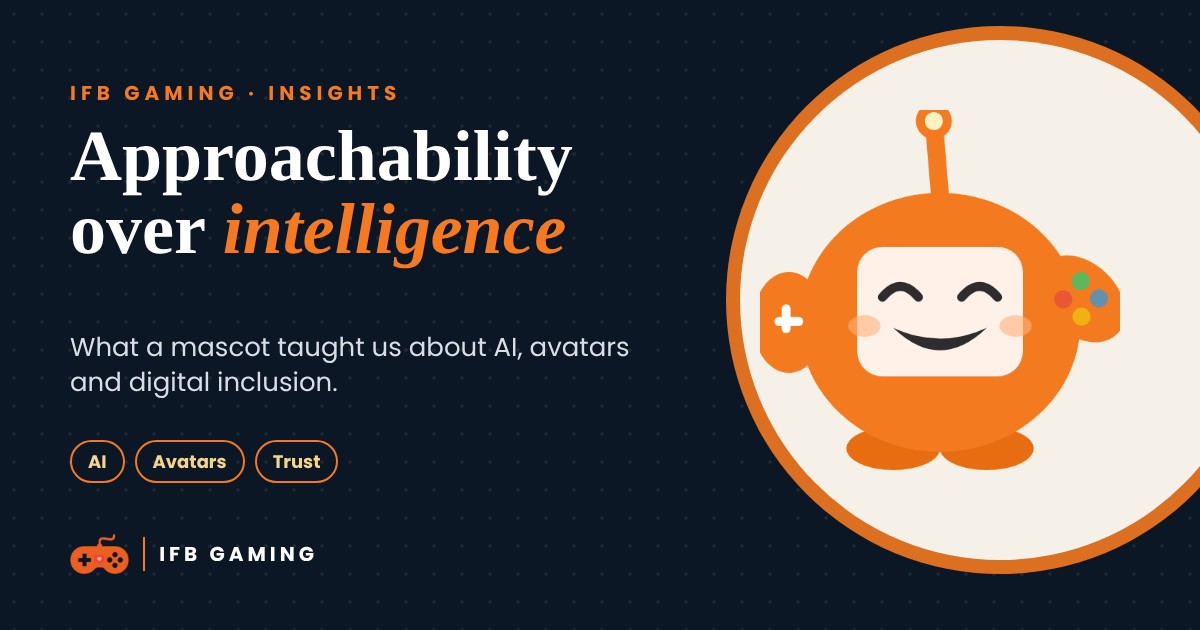
Approachability Over Intelligence: What a Mascot Taught Us About AI, Avatars and Digital Inclusion
The most important AI feature in digital inclusion isn’t intelligence. It’s approachability. We learnt that from a mascot.

Mr Chip isn’t an AI assistant. But people smile at him, stop for him and share him. He makes digital inclusion feel friendly before anyone has learnt a thing.
The real barrier is fear, not technology
For adults with low digital confidence, the barrier is rarely the technology itself. It’s the fear of looking foolish.
Calling a helpline can feel like a test. A dense manual can feel like proof you’re already behind. So people don’t ask the “basic” question, and the basic question is where everything starts.
Mr Chip, IFB Gaming’s digital inclusion mascot, doesn’t answer questions. What he does is change the mood. A friendly, familiar face tells people that this is a place where it’s fine not to know yet. As more organisations turn to AI assistants to support their communities, that lesson matters more than ever.
Three principles we’ve learnt, and would build in from day one
Lower the intimidation first
A reassuring guide changes the emotional starting point. Gaming has known this for decades: a good guide makes the first level feel safe. AI for inclusion should borrow that playbook.
Make it local, not generic
In boroughs like Southwark, Lambeth and Croydon, language is a real and documented barrier. AI that speaks to people in the language they think in is inclusion. AI that only speaks one language is another wall.
Scale the frontline, don’t replace it
Grassroots organisations rarely get funding for more staff. A well-designed assistant could offer support at 10pm on a Sunday, when no hub is open. But it must always know when to hand over to a human: for example, flagging a safeguarding concern straight to a trained person, or booking someone a slot at their nearest community hub.
An AI guide is only inclusive if it’s honest about what it doesn’t know, safe with people’s data, and connected to real people and places. Otherwise it’s just a friendlier jungle.
Lessons from a mascot, and why we’re now thinking about avatars
Mr Chip points to something bigger. Games solved the confidence problem a long time ago, and avatars are a big part of how they did it.
- Failing is safe. In a game, you can get it wrong and simply try again. People learning digital skills need the same freedom to practise online banking or spot a scam without real-world consequences.
- Progress is visible. Players watch themselves level up. People with low digital confidence rarely see their progress, so they rarely feel it.
- Identity is on your terms. An avatar lets people choose how they show up online. That is inclusion without assimilation: getting online as yourself, or as the version of yourself you choose, with privacy if you want it.
We see two roles for avatars in digital inclusion:
Guide avatars
Friendly characters like Mr Chip that lower the fear and make every tool feel like one familiar journey.
Learner avatars
A person’s own character that grows as their skills grow, making progress visible and worth celebrating.
Done well, avatars could turn digital inclusion from a jungle into a game people actually want to play. Done badly, they become a gimmick. So the same rules apply. Avatars should:
- be optional, with a plain view for adults who prefer it
- represent the full range of people we serve, including skin tones, dress and disability aids
- work on low-cost phones and with screen readers
- be tested with real learners, to prove they build confidence
The tensions we take seriously
Approachability isn’t automatically good. Three tensions shape how we’d test any of this:
- Warmth can create over-trust. A friendly guide that gets things wrong is more dangerous than a cold one, because people believe it. On sensitive topics like benefits, health or banking, any AI guide must point to trusted sources and real people, not improvise answers.
- Nobody wants another Clippy. Mascots that pop up uninvited quickly become irritating. A good guide waits to be asked, steps aside when someone just wants to get a task done, and is easy to switch off.
- Someone has to maintain it. Multilingual, accessible avatars that run on low-cost phones need ongoing investment. Grassroots organisations rarely get funded for upkeep, so this needs shared infrastructure and long-term funding, not one-off pilots.
Naming these tensions isn’t a reason to stop. It’s how we make sure approachability serves people, rather than simply impressing them.
Welcome comes before power
The future of AI in digital inclusion won’t be decided by the most powerful model. It will be decided by whether the people furthest from technology feel welcome enough to ask.
That is why our work starts with trust: trusted community spaces, clear pathways like the Stage Index and the London Digital Inclusion Atlas, and a friendly face that makes the first step feel possible. Digital inclusion should be baked in, not bolted on. So should trust.
If you’re designing AI for communities: what’s the first question you’d want your users to feel safe asking? Tell us on LinkedIn or email info@ifbgaming.com.
Work with us
We help organisations design digital support, and AI, that people actually feel welcome to use.
Meet Mr Chip Explore the Stage Index Get in touch