
Get Online Week 2026: From Getting Online to Being Able to Participate
Get Online Week 2026: From Getting Online to Being Able to Participate
There is something fitting about IFB Gaming approaching another Get Online Week by looking backwards before looking forwards.
For more than a decade, digital inclusion has been part of our community work. But the meaning of “getting online” has changed considerably during that time.
When someone first sits down with a computer or smartphone, the challenge can appear straightforward. How do I turn it on? How do I connect? How do I send an email? How do I search for something? How do I stay safe?
But increasingly, those are only the beginning.
Today, people are expected to use digital systems to access healthcare, communicate with public services, apply for work, manage finances, learn, shop, access information and participate in community life. And now, increasingly, they are expected to understand systems incorporating artificial intelligence.
So the question facing digital inclusion is changing.
It is no longer simply: can someone get online?
It is: can they participate meaningfully and confidently in the digital systems around them?
That is the question we are taking into Get Online Week 2026.
What Get Online Week means to IFB Gaming
Get Online Week is the annual digital inclusion campaign led by Good Things Foundation. It has taken place every year since 2007, bringing organisations and communities together to raise awareness of digital exclusion and support people to develop the skills and confidence they need to participate in an increasingly digital society.
For IFB Gaming, however, Get Online Week has never been simply a calendar event. It has been a practical testing ground, a place where ideas about digital inclusion meet real people, real services and real barriers.
Our wider digital inclusion work dates back to 2015. Our public archive records our first documented Get Online Week activity at Brandon Estate in Southwark in 2018. By 2023, IFB Gaming described that year’s activity as our sixth Get Online Week campaign.
That history matters because our understanding of digital inclusion has changed through practice. We have not simply been observing digital exclusion. We have been learning from what happens when people encounter it.
The first lesson: access is necessary, but it is not enough
Our early work reinforced something that is easy to miss when digital inclusion is discussed through statistics.
People do not experience “digital exclusion” as a single problem. One person may not have a device. Another may have a device but no affordable data. Another may have connectivity but lack confidence. Another may know how to use a smartphone but struggle with an online public service. Another may have the skills but encounter an accessibility barrier. Another may simply not trust the system.
These are different problems, and they require different responses.
That is one reason why Get Online Week has always mattered at community level. It creates an opportunity to meet people where they are, rather than assuming that everyone starts from the same place.
Brandon Estate: where the work became local
In 2018, IFB Gaming brought Get Online Week activity to Brandon Estate in Southwark.
At the time, our reflection was straightforward: national digital inclusion campaigns were important, but there was a need to make that activity visible and accessible within the local community.
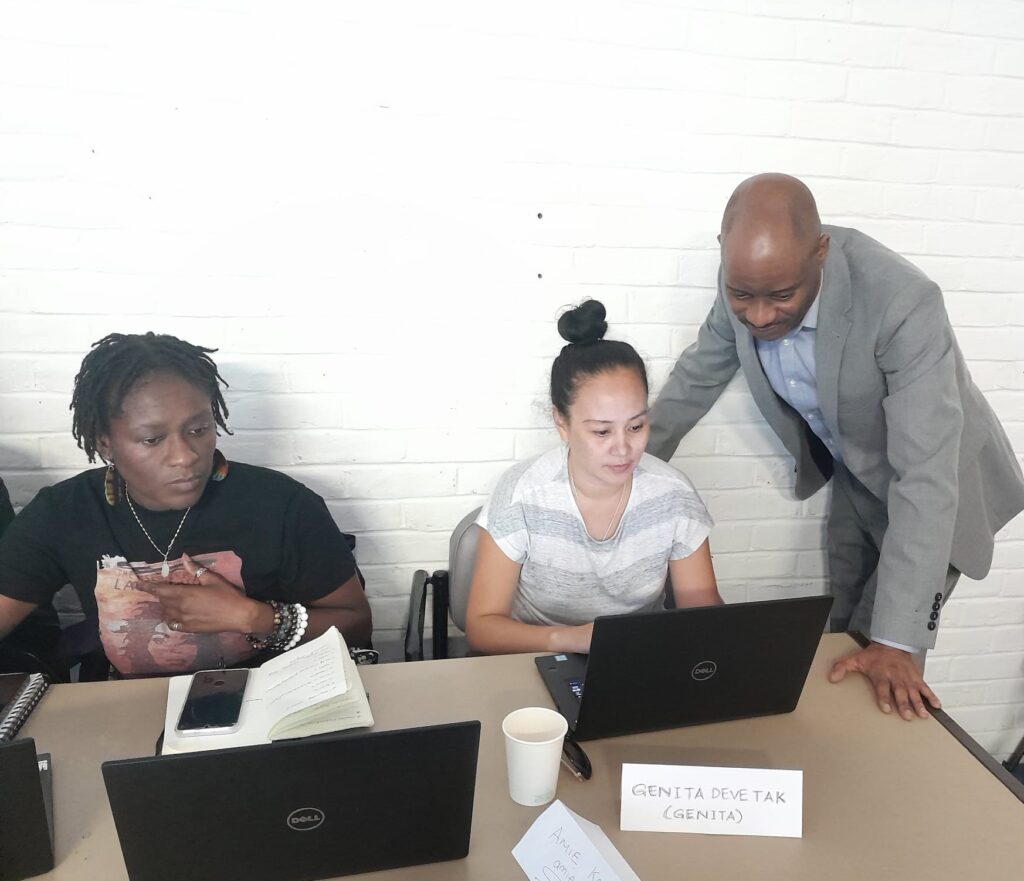
That experience became part of a longer body of work. By 2023, Get Online Week activity across Brandon Estate and Kennington included community focus groups, support with NHS appointment systems, National Databank support, digital-skills activity, business technology workshops for women and digital-skills and needs assessment work with residents.
This is significant because none of those activities can really be described as simply “teaching people computers.” They were about helping people navigate the systems through which everyday life was increasingly being delivered.
One resident described the practical significance of the experience particularly clearly after sending her first email:
“If I need to email the council, I can do that – I don’t need to wait for them.”
That is a small technological achievement. But it is also an increase in agency. And that distinction has stayed with us.
Digital inclusion happens between organisations
One of the biggest lessons from community delivery is that no single organisation can solve digital exclusion on its own.
A person may need a device, connectivity, digital skills, accessibility support, confidence, trusted human assistance, access to a particular service, somewhere to practise, or somewhere to go when something goes wrong.
These resources often sit in different organisations. A community organisation might identify the need. A library might provide a space. A connectivity programme might provide data. A technology provider might supply a device. An accessibility organisation might address a barrier. A council might provide the service. A volunteer might provide the confidence to take the first step.
The individual experiences one journey. The system often sees several separate transactions. That gap matters.
The infrastructure behind inclusion
Interestingly, this is not only something we have learned through community work.
Research commissioned by the UK government into Get Online Week 2023 examined how digital infrastructure translated into digital inclusion and public value. Its findings highlighted the role of libraries, local authorities, charities, community organisations, volunteers and private-sector organisations in turning infrastructure into meaningful digital inclusion activity. The research also identified collaboration between public, private and third-sector organisations as an important part of the process.
That reflects something we have increasingly seen ourselves.
There has to be something around the infrastructure: people, relationships, knowledge, support, referral pathways, accessible services, places to learn, places to ask questions, places to return to.
This is why our thinking has moved from access towards participation, and increasingly towards the infrastructure that makes participation possible.
From Get Online Week to From Devices to Impact
That evolution has shaped our current work.
In 2026, IFB Gaming launched From Devices to Impact, our interactive digital inclusion toolkit. The premise is deliberately simple: what happens after the device?
A device can remove a barrier. But it does not automatically create participation. What happens afterwards is what matters.
Can the person communicate? Can they learn? Can they work? Can they access healthcare? Can they navigate public services? Can they stay safe? Can they build confidence? Can they participate independently?
The toolkit was developed to help individuals and organisations think beyond the distribution of technology towards the conditions required for meaningful digital participation. It includes the Stage Index, designed to help users understand where they are in their digital inclusion journey and what they may need to do next.
This is a natural progression from the questions we encountered through community delivery.
From measurement to action
The Stage Index has emerged from another question: what happens when we identify the problem?
Digital inclusion measurement is important. But measurement is not an outcome. Knowing that someone has a barrier is useful only if the system can respond appropriately.
Is the next step training? A device? Connectivity? Accessibility support? A referral? Human assistance? A different service design? Or something else entirely?
This is why we are increasingly interested in the relationship between assessment, action and outcomes. The objective is not to create another layer of measurement. It is to make information more useful.
Why this matters even more in 2026
The digital environment has changed considerably since our early Get Online Week work. We are now moving into an environment shaped by automation and artificial intelligence.
That creates enormous opportunities. It also creates another layer of complexity.
Someone can be technically online and still struggle to understand an AI-enabled service. They may not know when an automated system is making a decision. They may not know what information they should or should not provide. They may not know how to check an AI-generated answer. They may not understand how a service has changed because AI has been introduced.
And people who were already experiencing barriers to digital participation may encounter new ones.
This is why we believe AI literacy should not be separated from digital inclusion. The answer is not to expect everyone to become an AI specialist. It is to make sure people can understand, question and participate in the systems increasingly shaping their lives.
Get Online Week 2026
This year’s UK Get Online Week takes place from 19 to 25 October 2026.
Good Things Foundation has described the 2026 campaign as a slightly different approach, with a stronger emphasis on raising awareness of the impact of digital exclusion and encouraging advocacy, including engagement with MPs and councillors. Organisations can still use the campaign resources to support people locally.
We think that shift is important, because digital exclusion is not simply an individual problem. It is also a question about how society designs participation.
If essential services become digital, we need to ask whether people can use them. If work becomes increasingly digital, we need to ask whether people can participate. If healthcare becomes increasingly digital, we need to ask whether people can access it. If AI becomes embedded into everyday systems, we need to ask whether people understand enough to participate safely and confidently.
These are questions for communities. But they are also questions for organisations, service designers, technology providers, funders and policymakers.
What we are doing differently
For Get Online Week 2026, our focus is therefore broader than simply encouraging people to “get online.”
We want to help people understand what digital inclusion actually is and, importantly, understand that they can play a part in it.
That includes the people already doing community work. It includes organisations distributing devices and connectivity. It includes volunteers providing one-to-one support. It includes accessibility specialists. It includes libraries and community spaces. It includes researchers. It includes public services.
And it includes people who may never have thought of themselves as part of the digital inclusion ecosystem.
Including gamers.
At IFB Gaming, our work has always explored what gaming can teach us about learning, participation, confidence and social interaction: the patience involved in helping someone solve a problem, the willingness to try again after failure, the ability to learn through experimentation, the importance of feedback, the motivation created by progress.
These are not exclusively gaming behaviours. They are useful human capabilities. And they can have a place in digital inclusion.
You do not need to be an expert
One of the messages we want to reinforce this Get Online Week is simple: you do not have to be a digital expert to help someone participate.
Sometimes digital inclusion looks like sitting beside someone while they complete a form. Sometimes it means helping someone understand an online appointment system. Sometimes it means finding a suitable device or connectivity pathway. Sometimes it means explaining something without making the person feel embarrassed for asking. Sometimes it means knowing where to refer someone when the problem is outside your expertise. And sometimes it means simply giving someone enough confidence to try.
Digital inclusion is therefore not one organisation. It is an ecosystem.
Ten years of learning, one question for the future
Looking back at the work, the biggest change is not the technology. It is the question we ask.
The earlier question was: how do we help people get online?
Then: how do we help people develop digital skills?
Then: how do we help people participate?
Now we are asking: what systems and infrastructure are required to sustain meaningful participation?
That is a much bigger question. And it cannot be answered by one organisation. It requires collaboration, evidence, community insight, accessible design, good referral pathways, practical support, responsible technology, and a willingness to listen to the people who experience exclusion first-hand.
Get involved with Get Online Week 2026
From 19–25 October 2026, Get Online Week will bring organisations and communities together across the UK to raise awareness of digital exclusion and support greater participation in digital society.
At IFB Gaming, we will be using the week to continue the conversation that began through years of community delivery and has now informed our work on From Devices to Impact, the Stage Index, community support and our wider research into digital participation.
If your organisation is already doing digital inclusion work, we want to hear from you. If you are supporting people who are struggling with digital access, skills, confidence or participation, we want to understand what you are seeing.
And if you have never considered yourself part of digital inclusion, perhaps this is the week to ask: what could I do to help someone participate?
Because getting online was never really the destination. It was the beginning.
The work now is helping people participate in the world that comes after it.