

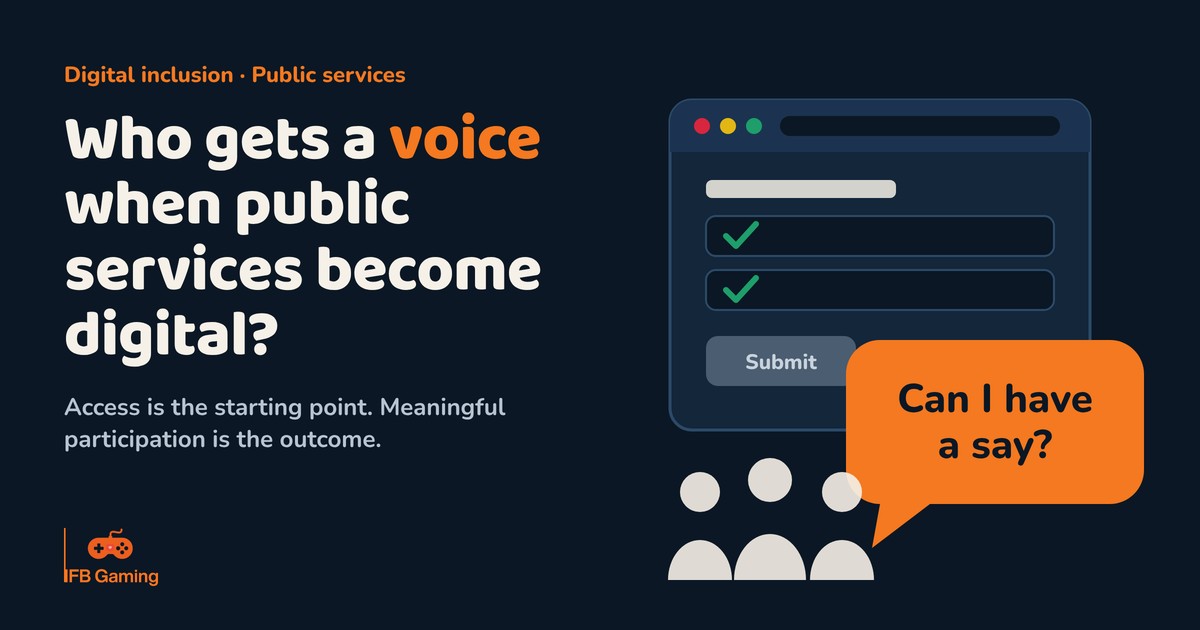
Who gets a voice when public services become digital?
Digital inclusion · Public services · Governance
Applications, appointments, consultations and complaints are moving online. That brings real benefits. But for every service that goes digital, one question matters as much as whether it works: who still gets a say?
Digital services can be quicker, cheaper and open around the clock. They can also quietly shut people out, not of the service itself, but of the power to question it, challenge it and shape it.
Access is not the same as participation
Someone can complete an online application and still have no real way to challenge the decision. Someone can receive a link to a consultation without the confidence, data or accessibility support to take part. Someone can be connected and still be left out of decisions about their housing, health, education or neighbourhood.
Access asks
Can people get to the service and complete the task?
Participation asks
Can people understand it, question it, get human help, challenge decisions and influence how it changes?
Digital inclusion should be judged by both.
Designed for the confident, by default
When services are built around people who are already confident online, others are left to fit in or drop out. That includes people in data poverty, disabled people, people with limited English, older people, people with low literacy, and people who rely on someone else to get online for them.
The problem is rarely that these people don’t want to take part. Often, the route offered to them doesn’t work for them. That is why inclusion has to be part of how a service is designed, not a fix added after people have already been excluded.
A governance question, not just a technology one
Every digital transformation programme should be able to answer these questions:
- Who is accountable when someone can’t use an essential digital service?
- What is the alternative for people who can’t, or don’t want to, go online?
- How are the people who use a service involved in designing and evaluating it?
- Can people understand and challenge automated decisions?
- Are community organisations involved early enough to spot the barriers institutions miss?
Most councils can’t yet see what changes
The Local Government Association’s 2026 research, Funding, structuring and supporting digital inclusion in local government, makes the measurement gap plain.
of responding councils use long-term outcome tracking for digital inclusion to a moderate or great extent. Around a third don’t use it at all.
9 of 83 councils responding to the LGA’s 2026 Digital Communities Survey. The LGA notes that councils already active in digital inclusion were more likely to respond, so the true figure may be lower.The report links this to short-term funding: temporary teams can’t collect long-term data, and without that data it is hard to make the case for investment. It recommends measuring how dense, coordinated and lasting local support is, not just counting outputs from individual projects, and treating evaluation as its own programme-level activity.
We agree. If we only count devices handed out or sessions delivered, we will never know whether people gained a voice.
Community infrastructure makes participation possible
Community organisations, libraries, learning providers and digital inclusion networks offer what technology alone can’t: a place to ask questions, get support and build confidence at your own pace. They also show institutions experiences that never appear in service data.
This is where IFB Gaming works:
- Empowering Futures and our DataWaypoints connect people, provision and place, through trained Digital Champions and partner sites that give out free data.
- From Devices to Impact starts from the idea that access is only the beginning.
- The London Digital Inclusion Atlas maps the local support around people, the density and coordination the LGA says councils need to see.
- The Digital Inclusion Stage Index looks beyond connectivity and tracks progress over time, the long-term measurement most councils don’t yet have.
From consultation to influence
Asking for feedback is not the same as sharing power. Participation shouldn’t end when a survey closes. People should be able to help design services, name barriers, judge what works and shape future priorities.
That takes accessible communication, trusted relationships, the right support, and feedback that shows people what happened to their views. And it means keeping real alternatives for people who can’t or don’t want to take part online.
Seven pillars, one participation challenge
Our seven pillars of Future-Proofed Communities show how digital change reaches every part of life. Exclusion in one can create barriers in the others.
Digital citizenship
Can people find and understand information?
Education
Can everyone take part in digital learning?
Living
Can people manage everyday digital services?
Commerce
Can people take part in the digital economy?
Healthcare
Can people use and understand digital health services?
Governance
Can people influence decisions that affect their communities?
Safety and security
Can people take part without avoidable risk?
A better test of digital transformation
A service isn’t transformed just because it has moved online. Before calling it done, ask:
- Can everyone access it?
- Can people understand it?
- Can they use it with confidence?
- Can they reach a human when they need one?
- Can they challenge decisions?
- Can they influence how it develops?
The future of public services shouldn’t be judged only by how efficiently institutions use technology. It should be judged by how well people can take part in the systems that increasingly shape their lives.
Measure what actually changes
If your council or organisation wants to understand the support around the people you serve, and track whether it makes a lasting difference, we’d like to talk.
Try the Stage Index Explore the AtlasOr email cas@ifbgaming.com
IFB Gaming · Play. Learn. Participate.
Source: Local Government Association, Funding, structuring and supporting digital inclusion in local government (2026). Survey fieldwork February 2026; interviews April 2026.