

Only 1 in 3 of us are comfortably online. Here’s what that looks like in south London
Blog · Digital inclusion · Policy
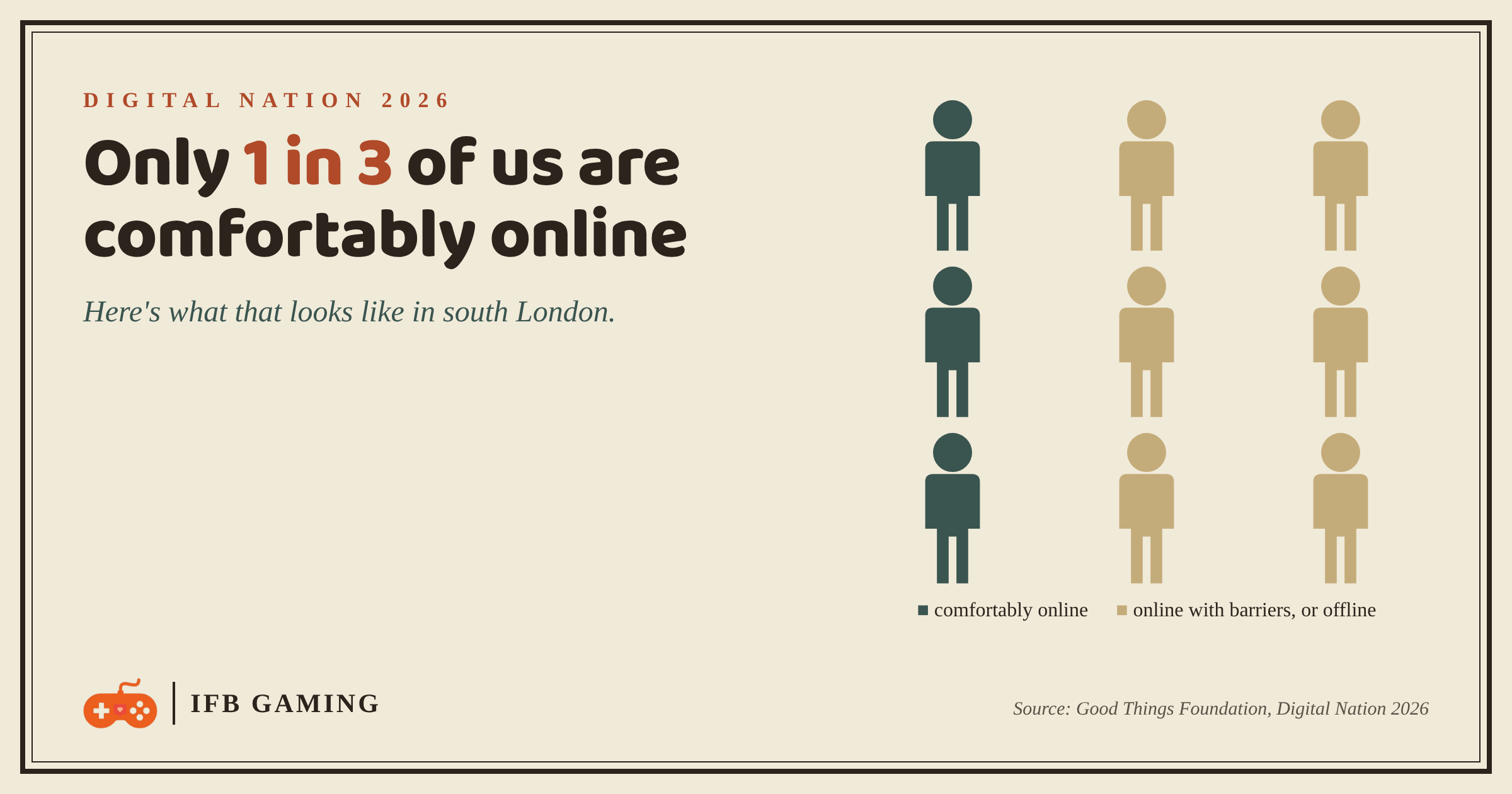
New research from Good Things Foundation shows that only 1 in 3 UK adults are comfortably online. Another 34 million are online, but face barriers or vulnerabilities. That second number is the one we recognise, and it’s a national problem, not a local one.
Online, but not okay
Most people who come to IFB Gaming have a phone. What they don’t have is enough data to last the month, a device that runs the app they need, or the confidence to manage Universal Credit, a job application or a doctor’s appointment online without help. Being “online” isn’t the same as being included.
Why south London is a national testbed
We call ourselves the R&D of UK digital inclusion because south London concentrates, in a few square miles, the pressures that drive digital exclusion in cities across the UK: dense housing and heavy use of temporary accommodation, many languages spoken at home, high living costs, and essential services that have moved online. If an approach works on a south London estate, it has been tested against those pressures all at once.
That’s why we build tools here that other places can use: the Southwark Digital Inclusion Ecosystem Atlas, which maps local support so it can be compared with need, and the Digital Inclusion Stage Index, which tracks people’s digital journeys over time, not just whether they’re online on one day.
How to use the new research
- Digital Nation: use it to make the case. Most excluded people are online, but not safely or confidently. Push further: it’s a snapshot, and people fall in and out of inclusion every month.
- Indicators of Digital Inclusion: add two or three questions to your intake form to spot who needs help. Push further: they measure what people lack, not the services that shut them out.
- Minimum Digital Living Standard: make sure support covers connection, a device and skills together. Push further: staying connected is an ongoing cost, not a one-off.
- Partnership Pathway: councils, use it with community partners, not just internal teams. Push further: community organisations can be digitally excluded too.
- Greater Manchester: the UK’s most joined-up example. Its Digital Exclusion Risk Index covers every council area in England, and we’re testing it alongside our Southwark Atlas to map where help is missing.
We’ve set out the full detail, including seven questions from the lab and the data gaps we found in south London, in our research digest.
What national government should do
Local action can’t fix problems built into national services. Our asks:
- Department for Work and PensionsKeep a supported, non-digital route into Universal Credit and employment support, and make data and device support part of the offer for claimants who need it, so no one is sanctioned for a barrier they didn’t choose.
- NHS EnglandDesign for people on shared phones and limited data: every digital route to a GP or hospital appointment should have an equal offline route, and digital inclusion should be funded as part of tackling health inequalities.
- Ministry of Housing, Communities and Local GovernmentTreat connectivity as part of a decent home, including in temporary accommodation, where families lose connection every time they move.
- Department for Science, Innovation and TechnologyMeasure digital inclusion over time, not just at one point, and fund community organisations’ own digital capacity as part of national digital inclusion plans.
- Across governmentTackle data poverty as an ongoing cost: free SIM schemes are a vital bridge, but people need affordable connection that lasts.
Live in south London and need help?
Free SIM cards with data, help with devices and one-to-one support.
Request a free SIM Find local supportCouncils, funders and researchers
Want to test the Atlas or Stage Index in your area, or collaborate on the evidence? Let’s talk.
Collaborate with us Read the research digestOver to you: where do you see people who are online, but still struggling?
Sources: Good Things Foundation, Digital Nation 2026, the Minimum Digital Living Standard, the Indicators of Digital Inclusion and the Partnership Pathway; GMCA, Digital Exclusion Risk Index.