IFB Gaming

Loading

Digital Inclusion Works Better When a Place Works Together: A Look at Good Things’ Evidence

New positioning paper

Digital inclusion works better when a place works together

Our new positioning paper shows how the Stage Index supports a place-based approach.

We’ve written a short positioning paper for councils and local partners, and we wanted to introduce it here.

It builds on recent research from Good Things Foundation, Strengthening a place-based approach to digital inclusion, which makes a simple but important point: tackling digital exclusion in a place works best when local partners act as one coordinated system, not as a scatter of separate projects. That means a shared vision, shared leadership, a shared way of reaching the people who are excluded, and a shared way of measuring whether things are actually improving.

Where our toolkit fits

Our paper looks honestly at where the IFB Gaming Stage Index helps with that, and where it doesn’t. We’re clear about one thing up front: the Stage Index is not a partnership tool, and it doesn’t replace Good Things Foundation’s. The two do different jobs, and they work well side by side.

  • Good Things Foundation’s tool helps a place understand how well its partners are working together.
  • Our Stage Index gives those same partners a shared, resident-level evidence base to work together around.
  • Together, they help a place see who is excluded, agree what to do, and prove that it is making a difference.

The paper maps the Stage Index against the four areas the research highlights, and is honest about which ones a measurement tool can genuinely support and which depend on leadership and funding that no tool can supply. If you work in a council or a local partnership, we think it’s a useful, practical read.

How to get the paper

The full positioning paper is available on request, we’re happy to send it over.

Head to our contact page and, in the message field, just mention you’d like the place-based positioning paper.

We’ll get it straight back to you, and we’re always glad to talk about how it might apply to your area.

Contact us

How councils can use IFB’s digital inclusion toolkit

For local government

How councils can use our digital inclusion toolkit

Practical tools to understand, measure, and act on digital exclusion in your area.

If you work in a council, you already know digital inclusion matters. The harder question is usually: where do we even start, and how do we show it is working? That is the gap our toolkit was built to fill.

The problem most councils run into

Plenty of good work happens across a borough, in libraries, community centres, and local groups. But it is often scattered, hard to see, and even harder to measure. Most digital inclusion gets counted in things handed out: devices given, SIM cards distributed. Those numbers matter, but they do not tell you whether anyone is actually more included as a result.

That is the real challenge. Not a lack of effort, but a lack of a shared way to understand who is excluded, why, and whether things are improving. Without that, it is tough to plan, tough to join things up, and tough to make the case for funding.

How a council can use the toolkit

Our toolkit is free to start with, needs no login, and is built to be useful straight away. Here are the main ways councils are putting it to work.

1

Check where your council stands

There is a version of our Stage Index built specifically for councils, weighted around the things you actually deal with, like governance and strategy. It gives you a clear, scored picture of how mature your digital inclusion approach is, and where the gaps are.

2

Understand your residents

The quick Digital Inclusion Check and the fuller Stage Index help you see who is excluded in your area and why. That gives you real community insight, the kind that is genuinely hard to get, and exactly what you need for planning and funding bids.

3

Give your teams a shared language

Our From Devices to Impact toolkit gives frontline staff, libraries, and community partners one common framework and a set of real-life personas. Suddenly everyone means the same thing by “digital inclusion,” which makes joining things up far easier.

4

Join up local delivery

Our Data Waypoint model helps you map and connect the places already doing this work on the ground, turning scattered activity into a visible, coordinated network across the borough.

5

Show that it is working

Because the tools measure where people are and whether they are moving forward, not just what was handed out, you get evidence you can actually use in strategies, reports, and funding applications.

Free to start, more when you need it. The core tools are open for any council to use right now. When you want more, borough-wide rollout, tailored benchmarking, joined-up resident data, and support, that is where we work with you directly as a partner. We will always be clear about what is free and what is a commissioned piece of work.

Why work with us

We are a community organisation, not a big consultancy, so we get the realities of delivering this work on the ground. We care about people being genuinely included, not just counted. And we have done the groundwork councils ask about, clear privacy and data handling, an accessibility commitment, and tools designed around real residents rather than abstract user groups.

Let’s talk about your borough

Whether you want to start with the free tools or explore a fuller partnership, we would love to hear what you are working on and where we can help.

Strengthening Place-Based Digital Inclusion: Why Community-Led Support Matters

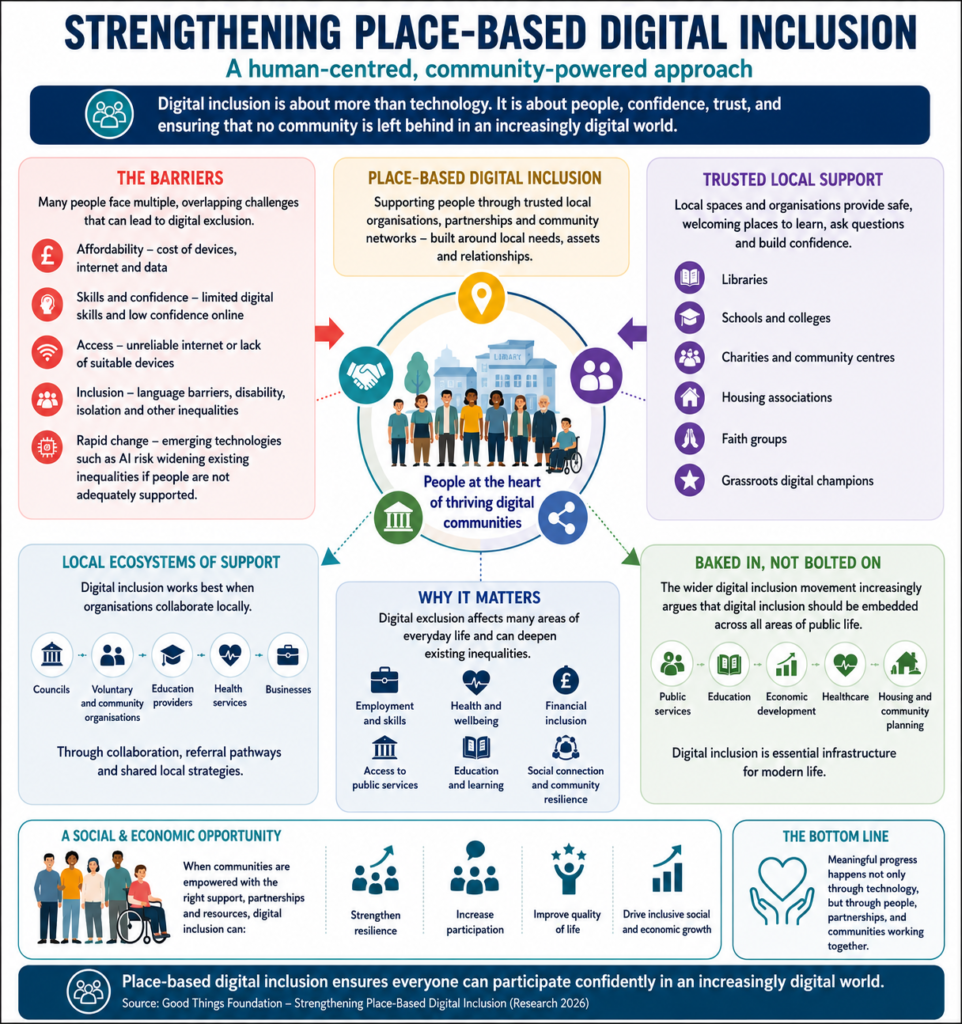
Digital inclusion is no longer just about access to devices or internet connectivity. Increasingly, it is about people, confidence, trust, and ensuring that no community is left behind in an increasingly digital world.

Recent research from Good Things Foundation highlights the importance of “place-based digital inclusion” — an approach focused on supporting people through trusted local organisations, partnerships, and community networks rather than relying solely on national or technology-led solutions.

The research recognises that many people still face significant barriers in today’s digital society. These challenges include affordability, lack of digital skills, low confidence online, language barriers, disability, social isolation, and limited access to support. As digital services continue to expand rapidly, there is growing concern across the wider digital inclusion sector that emerging technologies, including AI, could deepen existing inequalities if communities are not adequately supported.

One of the strongest messages from the research is that digital inclusion works best when support is rooted within communities. Libraries, schools, charities, housing associations, faith groups, community centres, and grassroots organisations often provide the trusted environments people need to learn, ask questions, and build confidence without fear or judgement.

The research also places strong emphasis on local ecosystems of support. Effective digital inclusion is rarely delivered by one organisation alone. Instead, it depends on collaboration between councils, voluntary organisations, educators, health services, businesses, and community partners working together through referral pathways and shared local strategies.

This local and human-centred approach matters because digital exclusion affects far more than internet access. It impacts employment opportunities, access to healthcare, financial wellbeing, education, civic participation, and social connection. In many cases, digital exclusion can deepen wider social and economic inequalities.

Across the wider digital inclusion movement, there is increasing recognition that digital inclusion should be “baked in, not bolted on.” In practical terms, this means embedding digital inclusion into public services, education, economic development, healthcare, housing, and community planning from the outset rather than treating it as a separate or temporary intervention.

Importantly, the research presents digital inclusion not simply as a technical challenge, but as a long-term social and economic opportunity. When communities are empowered with the right support, partnerships, and resources, digital inclusion can strengthen resilience, increase participation, improve quality of life, and support more inclusive economic growth.

As technology continues to evolve rapidly, the need for trusted community-based support has never been more important. Place-based digital inclusion reminds us that meaningful progress happens not only through technology, but through people, partnerships, and communities working together to ensure that everyone can participate confidently in an increasingly digital world.

Source: Good Things Foundation, “Strengthening Place-Based Digital Inclusion”

Connecting Community Insights to Policy

Connecting Community Insights to Policy, Toynbee Hall, 1pm-5pm

Join us at Toynbee Hall if you would like to engage with communities in more creative ways or learn about new ideas and approaches to embed community voice in your policies and programmes.

There will be opportunities to learn from those already delivering successful and impactful creative community engagement and peer research, and information about the support that is available to you from the GLA and other organisations. This includes the exciting launch of a new toolkit for GLA policymakers on how to commission peer research. Co-designed with a steering group of GLA officers, this toolkit will serve as a centralised hub of practical guidance and resources, ensuring that policymakers have the support they need to effectively commission peer research, whilst fostering meaningful community engagement.

We will hear from some of the first contributors to the GLA’s Community Insights Hub, who have been using creative methodologies such as film, photography, zine making and video-game principles to engage with communities and deliver impactful engagement projects.

There will also be an energising and practical workshop led by Neighbourly Labs, focused on participatory policy making and unpacking some of the challenges that we face when trying to carry out engagement work.


Sign up here

Lunch and refreshments will be provided.

IFB’s been shortlisted for a Business Excellence Award (2023) in London

Can Digital Unite Communities & Organisations Towards a Shared Vision? A Look at Get Online Week 2023

Let’s pretend for a second that this is not IFB Gaming – that our CEO, John Adewole, did not explore the efficacy and vitality of the gaming paradigm for project management and as a social accommodator for the insecurely attached through a longitudinal virtual ethnography. Let’s pretend that during his study, he did not capture the extent of modality switching from the gaming paradigm.

So what happened during Get Online Week?

IFB Gaming united charities and community organisations in Southwark for our 6th Get Online Week campaign in London. Get Online Week is championed by the UK’s leading digital inclusion charity, Good Things Foundation. The annual event sees the National Digital Inclusion Network get together to reinvigorate our pledges to eradicate digital inclusion and data poverty through collective action.

Now in its 16th year, the annual campaign has supported thousands of organisations to support millions of individuals at risk of digital inclusion and data poverty.

2023’s Get Online Week unfolded on Kennington and Brandon Estates in the London Borough of Lambeth and Southwark, respectively. Community development initiatives frequently necessitate educational programs, and during Get Online Week, we employed a dedicated educational app called Learn My Way.

The organisations that supported GOW 2023 include the NHS, NHS Digital, Good Things Foundation, Future Dot Now, and Vodafone’s Everyone.Connected, Metropolitan Police, and Virgin Media O2.

During the week;

  • We conducted focus groups with the Brandon Estates TRA committee and residents
  • We supported Seniors to master the new NHS appointment booking process via Swifqueue
  • We supported individuals through the National Databank
  • We supported individuals with basic digital skills using the EDS Framework
  • We empowered Women through Business Information Technology workshops
  • We explored new ways of doing research with NHS England in London communities
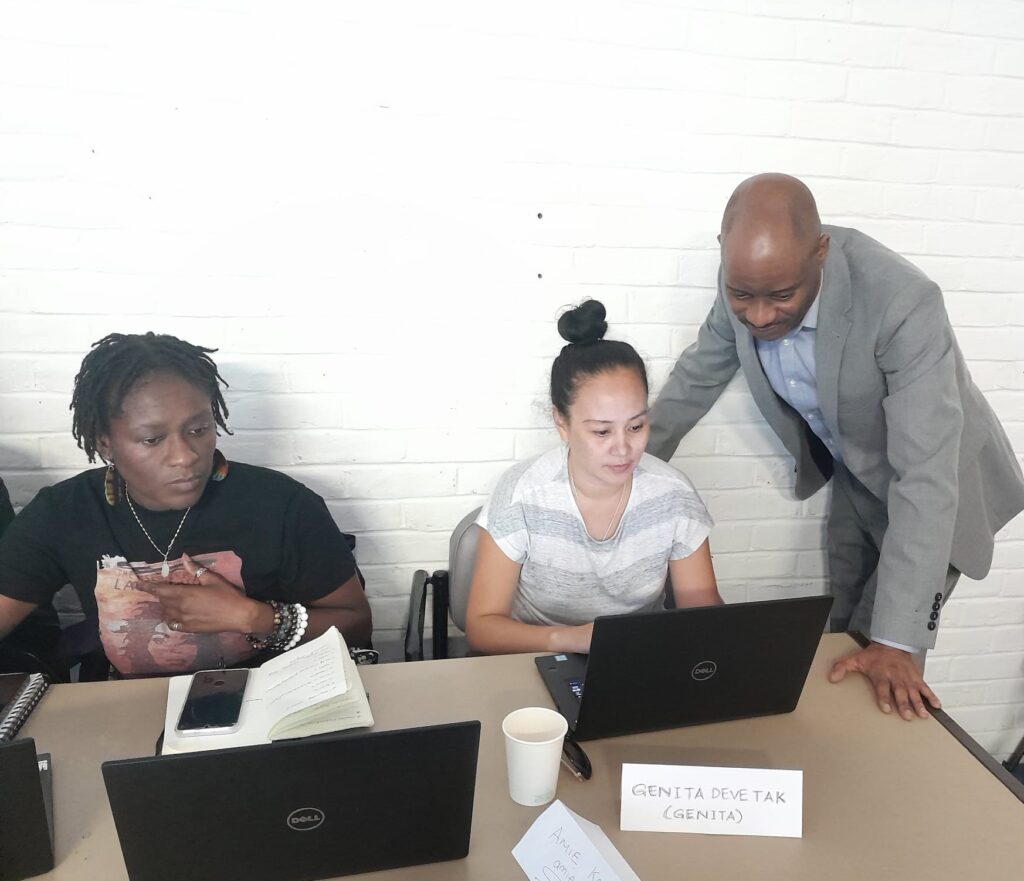
  • We conducted a Digital Skills and Needs Assessment with residents of Brandon Estate

So, can digital unite communities and organisations towards a shared vision and goals? In our operational research experience, we certainly have the data and insights to say yes! Digital can sustainably unite individuals and communities from the gaming paradigm towards a shared vision and goals; however, we have yet to establish whether it can from a real-world context.

Unlike real-world contexts where motive and motivation may differ significantly, the motive and motivation for presence in the gaming paradigm are playing and fun.

Ensure you are following our social media channels for more updates on the efficacy and vitality of digital to sustainably unite communities.

In the Press

Thank You for Inspiring Minds and Empowering Futures during Get Online Week in Southwark – John Adewole PMP

Get Online Week “Empowering Futures” – IssueWire

Kennington estate to host computer skills workshops for local residents – Southwark News

Success Story: Get Online Week with BREAKTHEBARRIER CIC – Community Southwark

– Get Online Week

Secure your bicycle with a Police marker

Join us on the 18th of October to get your bicycle security marked and logged on to the Bike Register for free!

It’s a highly effective, visible deterrent to bike thieves. They know that if they are caught with a registered bike, the owner can be traced and they will be arrested.

Marking kits may be limited so arrive early to avoid disappointment.

The event starts at 12pm and will finish at 2pm.

Thank you!

Upcoming Events