
Strengthening Place-Based Digital Inclusion: Why Community-Led Support Matters
Digital inclusion is no longer just about access to devices or internet connectivity. Increasingly, it is about people, confidence, trust, and ensuring that no community is left behind in an increasingly digital world.
Recent research from Good Things Foundation highlights the importance of “place-based digital inclusion” — an approach focused on supporting people through trusted local organisations, partnerships, and community networks rather than relying solely on national or technology-led solutions.
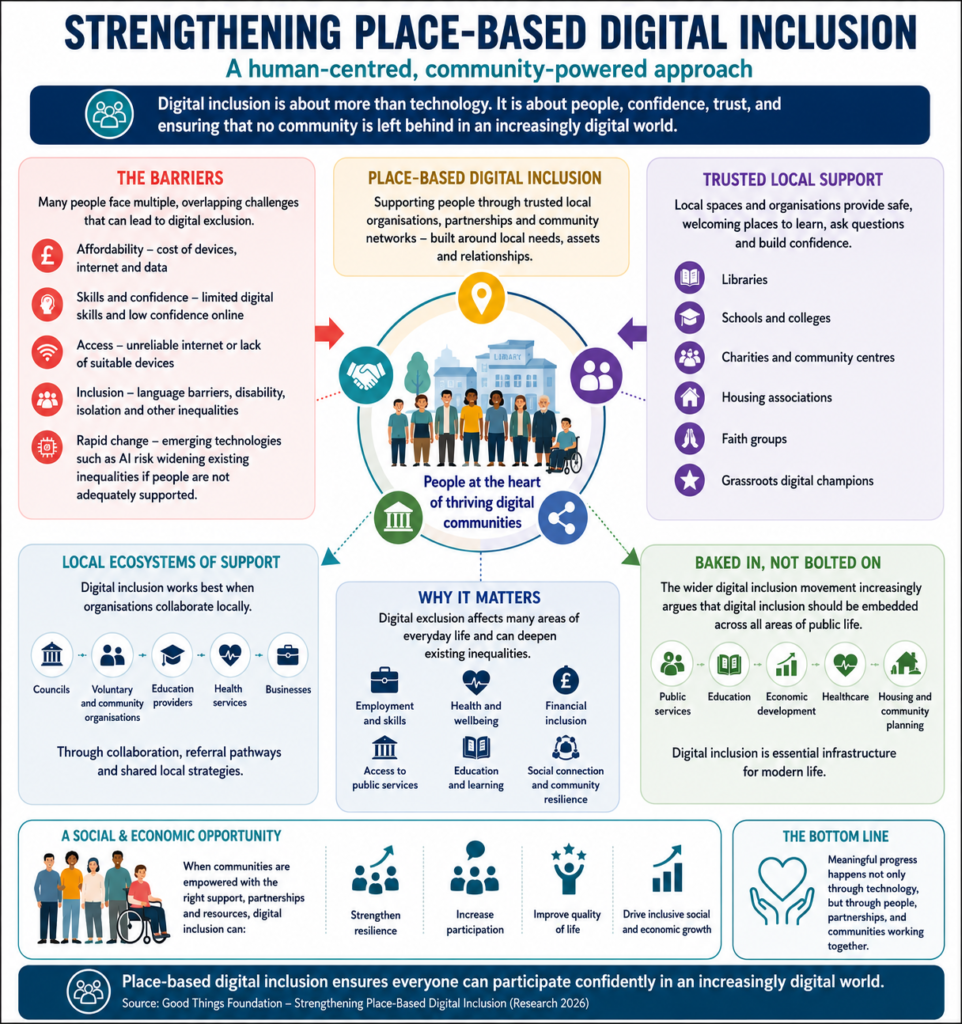
The research recognises that many people still face significant barriers in today’s digital society. These challenges include affordability, lack of digital skills, low confidence online, language barriers, disability, social isolation, and limited access to support. As digital services continue to expand rapidly, there is growing concern across the wider digital inclusion sector that emerging technologies, including AI, could deepen existing inequalities if communities are not adequately supported.
One of the strongest messages from the research is that digital inclusion works best when support is rooted within communities. Libraries, schools, charities, housing associations, faith groups, community centres, and grassroots organisations often provide the trusted environments people need to learn, ask questions, and build confidence without fear or judgement.
The research also places strong emphasis on local ecosystems of support. Effective digital inclusion is rarely delivered by one organisation alone. Instead, it depends on collaboration between councils, voluntary organisations, educators, health services, businesses, and community partners working together through referral pathways and shared local strategies.
This local and human-centred approach matters because digital exclusion affects far more than internet access. It impacts employment opportunities, access to healthcare, financial wellbeing, education, civic participation, and social connection. In many cases, digital exclusion can deepen wider social and economic inequalities.
Across the wider digital inclusion movement, there is increasing recognition that digital inclusion should be “baked in, not bolted on.” In practical terms, this means embedding digital inclusion into public services, education, economic development, healthcare, housing, and community planning from the outset rather than treating it as a separate or temporary intervention.
Importantly, the research presents digital inclusion not simply as a technical challenge, but as a long-term social and economic opportunity. When communities are empowered with the right support, partnerships, and resources, digital inclusion can strengthen resilience, increase participation, improve quality of life, and support more inclusive economic growth.
As technology continues to evolve rapidly, the need for trusted community-based support has never been more important. Place-based digital inclusion reminds us that meaningful progress happens not only through technology, but through people, partnerships, and communities working together to ensure that everyone can participate confidently in an increasingly digital world.
Source: Good Things Foundation, “Strengthening Place-Based Digital Inclusion”